Cheow Lan Lake is younger than most of the people who come to see it.
In 1982 this was a valley with a river running along the bottom of it and a village living beside the river. By 1987 the water had closed over all of it. Three hundred and eighty-five families moved up to higher ground and gave their new home a name that says exactly what happened to them.
Our grandfather is eighty-nine. He was forty-five when it started, and he was here for all of it.
All five, with real dates and prices
Per person, minimum two guests. Hotel pick-up both ways, a local guide, meals as listed, drinking water and insurance are included. The national park fee — 340 THB per adult, 170 THB per child — is cash at the gate, and it is the only thing we cannot collect for you. How the fee works.
- The Cheowlan Everyone Dreams Of A full day on the lake · every day · 09:30 3,800 THBper person Check dates
- The Khao Sok Way Elephants and a mountain kitchen · Sun, Wed, Sat · 12:00 7,900 THBper person Check dates
- The Khao Sok Adventure Worth Taking Jungle trek, waterfall and river tubing · Tue, Fri · 09:30 5,900 THBper person Check dates
- Life Around Cheowlan Village afternoon, bamboo raft and sunset · Mon, Thu · 12:00 5,900 THBper person Check dates
- Before the World Wakes Sunrise boat · Fri, Sat, Sun · 06:30 · Cheowlan side only 2,500 THBper person Check dates
Prices are per person and our minimum is two guests. Pick your month with the › arrow, choose a date, and the total for your group shows before you pay.
Ask us on WhatsApp Travelling alone, want a date that is not showing, or not sure which day suits you? We would rather answer the question than have you guess.
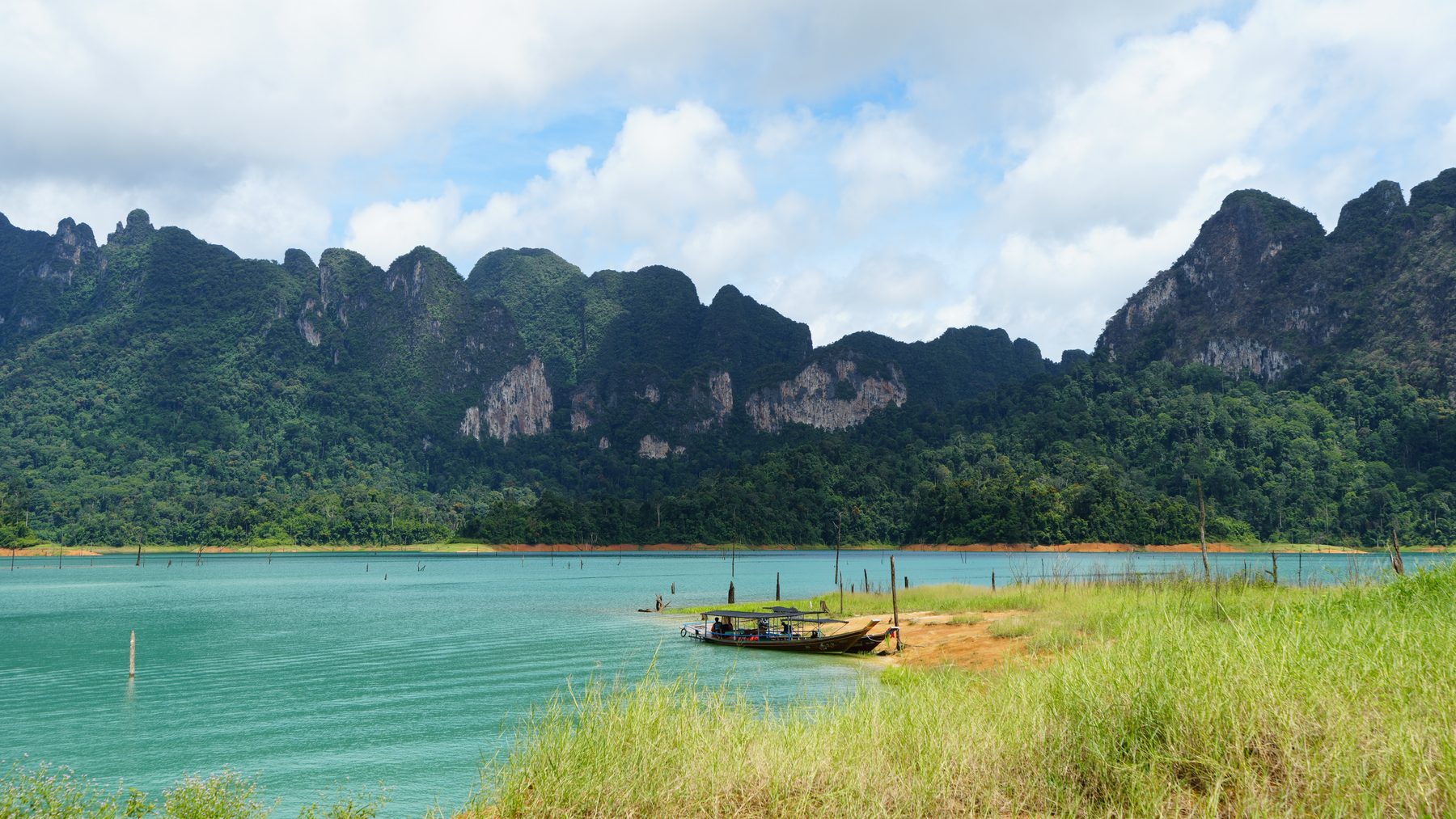
Almost everyone who photographs this lake believes they are photographing something ancient. It is an easy mistake — the limestone really is ancient, and the rainforest around it is one of the oldest on earth. But the water is not. The water arrived within living memory, and there are still people in the village who can tell you what was underneath it.
This is the part of Cheow Lan that no guide tells you, mostly because you have to be from here to know it.
The river that was here first
The Klong Saeng ran through this valley, and the limestone stood over it the way it stands over the water now — except you looked up at it from the valley floor, not from a boat.
Work on the dam began on 9 February 1982. It took five and a half years. On 30 September 1987 the dam was inaugurated, and King Bhumibol gave it its name: Rajjaprabha — light of the kingdom. You will see it written Ratchaprapha, and it is where the pier gets its name. Around here people just call it เขื่อน. The dam.
Behind it, the water spread out into 185 square kilometres of valley. Everything you see from the boat now was land. The limestone towers that look like islands were never islands. They were the tops of the hills.
หมู่บ้านจัดสรร — the allocated village
Before the water came, the people had to go. Three hundred and eighty-five families from Ban Chiew Lan were resettled out of the valley. Each family was given nineteen rai of rubber plantation on higher ground, and a payment every month while the young trees grew into something that could feed a family.
They rebuilt beside the dam. And the name they gave the new village was not a poetic one. It is หมู่บ้านจัดสรร — mùu-bâan jàt-sǎn, the allocated village. Named for the allocation itself. Land handed out so that people with nowhere left to stand could begin again.
Forty years later that is still its name. The rubber trees are still standing. This is where our family is from, it is where the boats leave from, and when we say the Cheowlan side, this is the place we mean.
Our grandfather is eighty-nine
He was forty-five when they started building the dam. Not a boy watching something happen to somebody else — a man with a life already built in the bottom of that valley, who was told it was going to be under water.
He is one of the very few people left who can tell you what it looked like with the river still running through it.
For a long time we did not think of that as a story. It was just what had happened to us, the way it had happened to everyone we knew. It took taking other people out onto the water to realise that nobody out there knows they are floating above somewhere.
That is really why this company exists. Not to show you a lake. To take you into a place that had a life before it was scenery, and is still full of the people it belonged to.


What the water covered, and what it made
Drowning a valley is not a gentle thing, and we are not going to pretend otherwise. But the forty years since have made something the valley never had.
There is a forest hidden inside the lake — you reach it by boat, and a waterfall stands at the entrance like a doorway. Inside there are water sources and trees big enough to stop you talking. A rainforest that rich, tucked inside a reservoir, is not something you expect to find.
There is a cave out on the water, cold the moment you step in, with what looks like diamond scattered across the rock.
And there is เขาสามเกลอ, the Three Brothers — three peaks standing together in a formation so deliberate it feels arranged. Nature putting on an exhibition.
The boat that takes you out to all of it is a wooden one, and a villager is driving it.
The one place you can see the whole story at once
A short drive above the village there is a hill, and from it you see two things in a single view: the dam, and the village the dam created.
The village looks tiny from up there. The forest looks like the whole world. And the sun goes down over both of them, which is a strange thing to watch once you know what is underneath.
That viewpoint is the last stop of Life Around Cheowlan, on Mondays and Thursdays. It is the only day of ours that ends with the story rather than the scenery.
Where to stand in this, if you are coming
To see the valley from above the water
The Cheowlan Everyone Dreams Of — the full day on the lake, in a wooden boat a villager drives. The Three Brothers, the cave, the hidden forest, lunch and a swim off a raft house. Every day. 3,800 THB.
To see where the people went
Life Around Cheowlan — lunch on banana leaves by the river, the village’s own waterways by bamboo raft, the forest the villagers call Turtle, and the viewpoint at sunset where the dam and the village sit together. Mondays and Thursdays. 5,900 THB.
To see it at first light
Before the World Wakes — on the water at 6:30, back by 8:30. Friday to Sunday, from the Cheowlan side. 2,500 THB.
Not sure how long to give the place? How many days you actually need in Khao Sok has the weekly schedule and an honest cost table, park fee separated out.
Questions people ask about the lake
Is Cheow Lan Lake man-made?
Yes. It is a reservoir, formed when the Ratchaprapha Dam closed across the Klong Saeng river. Construction began on 9 February 1982 and the dam was inaugurated on 30 September 1987. The limestone towers that look like islands were the tops of hills before the water rose.
How old is Cheow Lan Lake?
About forty years. The dam was inaugurated in September 1987, so the lake is younger than most of the people who travel to see it. The rainforest around it is a great deal older.
Was a village flooded to make the lake?
Yes. 385 families of Ban Chiew Lan were resettled before the valley filled. Each family received nineteen rai of rubber plantation and a monthly payment while the trees grew. They rebuilt on higher ground beside the dam, in the village whose name means the allocated village.
What is the dam called?
Rajjaprabha Dam, usually written Ratchaprapha. King Bhumibol gave it the name at the opening in 1987; it means “light of the kingdom”. The pier the boats leave from carries the same name.
Can you still see the old village under the lake?
No. The valley floor is under the water and stays there. What you can see is where its people went — the village beside the dam where the boats leave from, and the hill above it where the dam and the village sit in one view.
Where do the boats leave from?
Ratchaprapha Pier, on the Cheowlan side, beside the village the dam created. About ninety minutes from Surat Thani airport and roughly forty-five minutes from Khao Sok town. Hotel pick-up from either side is included on every experience we run.